When to replace your AC, and when a repair will do
On this page · 8 sections
When an air conditioner quits on a hot afternoon in Portland, Gresham, or Beaverton, the first question most homeowners ask is whether the whole system is done. Sometimes it is. A lot of the time it isn't. A unit that won't start, blows warm air, or trips a breaker can be failing for reasons that have nothing to do with its age, and a new system won't fix a problem that was never in the old one.
We'd rather fix your AC the right way the first time than sell you equipment you didn't need. That's why this post walks through how we actually make the call: what's broken, what refrigerant the system runs on, whether the problem is one part or the whole machine, and whether the person telling you to replace it has shown you why.
The short answer
Bottom Line Up Front
If one part failed — a capacitor, a contactor, a breaker, a single leak — repair it. If the compressor is gone, the system runs on R-22 and keeps leaking, or several major parts are failing at once, replace it.
Replacement gets recommended far more often than it's needed, because a new unit is the bigger sale. But there is a point where repairs stop paying off, usually when a phased-out refrigerant, a worn-out compressor, and a corroded coil all show up on the same system. The trick is getting an honest diagnosis before you decide.
We make it right at no charge
systems we usually install
emergency calls
The rest of this post is the four questions behind that answer, plus a decision matrix at the end you can run through on your own before you ever pick up the phone.
Question 1: What actually failed?
Most cooling problems we diagnose turn out to be electrical or a low refrigerant charge, not a dead system. A weak capacitor, a burnt contactor, a loose wire, or a breaker that's the wrong size can all stop an air conditioner cold while the compressor and coils are perfectly healthy. Those are repairs, and they're usually found with a meter in a single visit. If you want to see the usual suspects, we cover them in our post on common AC failures.
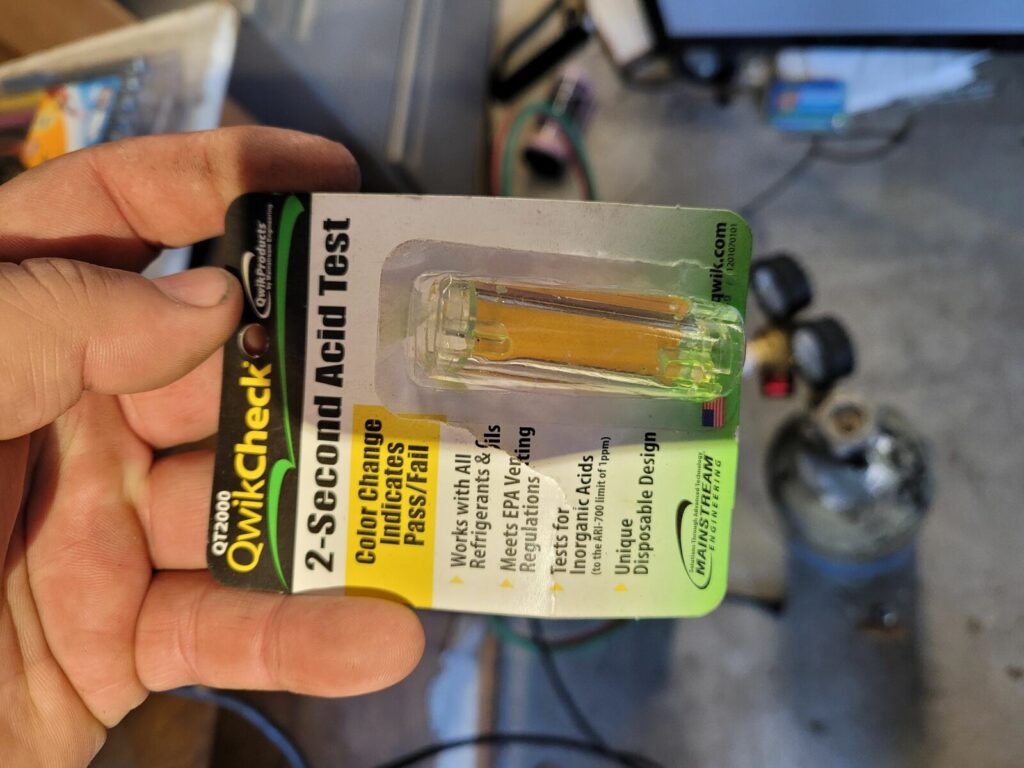
The answer changes when the compressor itself has failed. A compressor burnout can leave acid in the refrigerant and oil, and that contamination will damage new parts if it isn't dealt with. On an older system, a failed compressor is often the point where replacing the outdoor unit, or the whole system, makes more sense than rebuilding it.
Repair vs. replace at a glance
Here's the comparison we'd walk you through in the side yard, standing next to the condenser. Each row is a real factor, and the highlighted cell is the smarter call when that factor is the one driving your decision.
| Factor | Lean Repair | Lean Replace |
|---|---|---|
| What failed | Capacitor, contactor, wiring, or breaker | Compressor, with acid in the system |
| Refrigerant type | R-410A or newer | Phased-out R-22 |
| Refrigerant history | One leak, found and fixed | Needs a recharge every season |
| Coil condition | Dirty but cleans up | Corroded coil and rusting drain pan |
| Number of problems | One clear cause found with a meter | Several major parts failing together |
| Cooling performance | Cooled fine until it quit | Never kept up, even when working |
| Existing cooling | Nothing to repair | Ducts in place, no AC yet: retrofit |
Look at the breaker panel and see whether the AC or furnace breaker has tripped. Check whether the thermostat screen is blank, since weak batteries can make a working system look broken. Then step outside and see whether the fan on top of the condenser is spinning. When you call us, we'll talk through these same checks over the phone, and sometimes that's enough to know whether you need a visit at all.
Question 2: What refrigerant does your system run on?
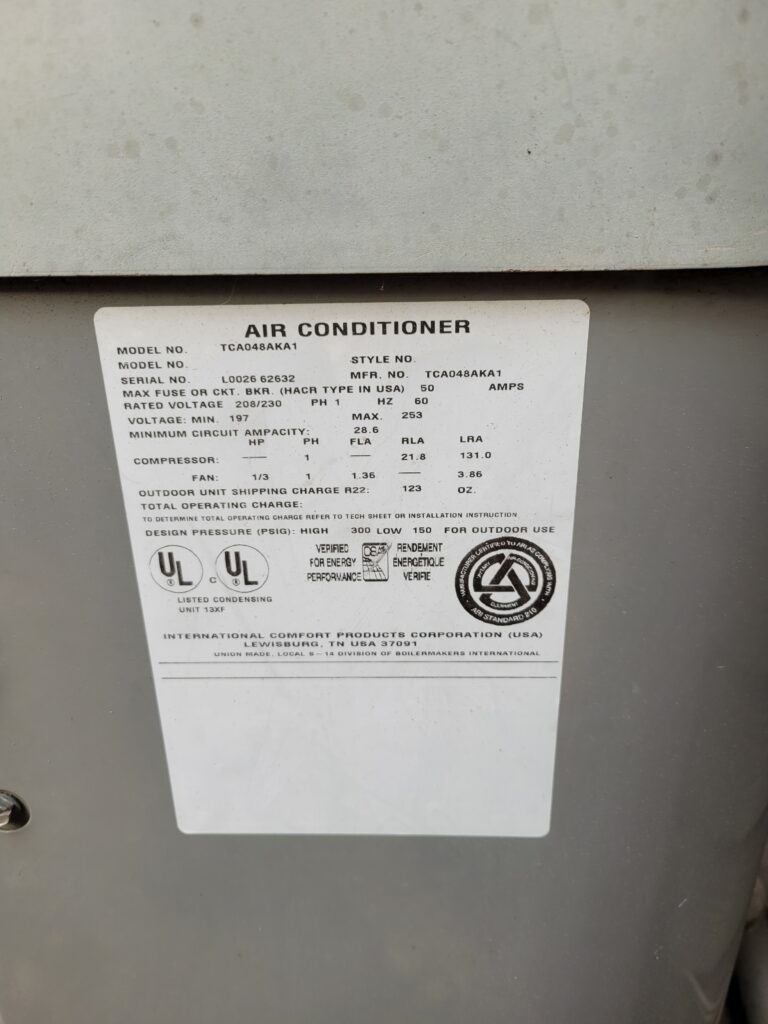
Look at the data plate on the side of your outdoor unit. If it lists R-22, your system runs on a refrigerant that has been phased out and is no longer produced, so every recharge gets harder to source and more expensive. That doesn't automatically mean replacement. We've recharged R-22 systems that had plenty of life left. But if an R-22 system is leaking and needs refrigerant every season, you're paying over and over for a problem that a new system ends for good.
Newer systems on R-410A or newer refrigerants are a different story. A leak on one of those is a find-it-and-fix-it job: pressure test the lines, locate the joint, repair it, pull a vacuum, and weigh in the correct charge. That's a repair, not a reason to start over.
Signs it's a repair
The system is sound and the problem is contained. Fix it and get back to cool air.
What we look for
- The outdoor fan or compressor won't start, and a meter traces it to a capacitor, contactor, or loose connection.
- The breaker keeps tripping, and it turns out to be undersized or worn rather than the equipment drawing too much.
- Pressures read low, and a single leak shows up at one joint that can be repaired and recharged.
- The condenser coil is packed with leaves and dirt but cleans up without corrosion underneath.
Signs it's a replacement
The system is failing as a whole. More repairs buy a summer, not years.
What changes the answer
- The compressor has failed, and an acid test shows contamination in the refrigerant and oil.
- The data plate says R-22, and the system has needed refrigerant more than once.
- The indoor coil and drain pan show heavy rust and green corrosion, not just dirt.
- The home has central air ductwork but has never had cooling, so there's nothing to repair.
Question 3: Is it one part, or the whole machine?
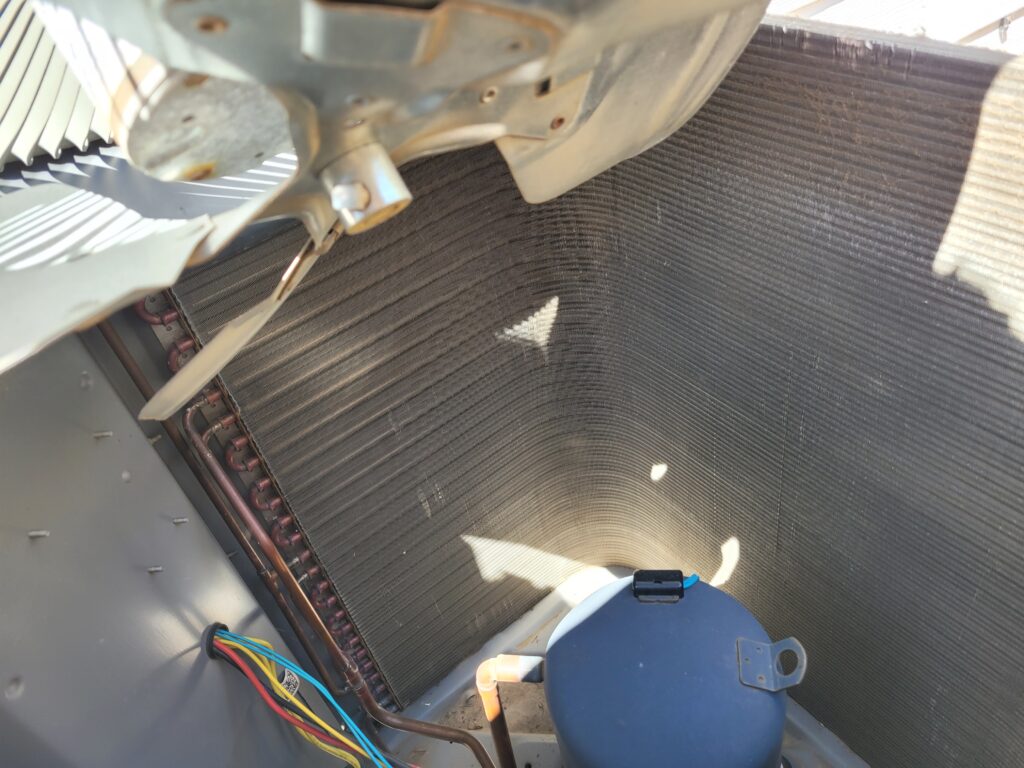
One failed part on an otherwise healthy system is a repair. Several failures stacking up at once tells a different story: a corroded coil, a rusting drain pan, a compressor buried in years of leaves and debris, and a refrigerant leak, all on the same unit. At that point you're not fixing a problem, you're keeping a worn-out system on life support, and regular maintenance can only stretch it so far.
When replacement is the right call, we usually install Goodman. It comes with a ten-year warranty, and it has fewer bells and whistles than some of the big-name brands, which is a good thing for long-term reliability. Paying twice the price for a name doesn't get you twice the system. You can read more about how we handle AC replacement and installation, including retrofits for homes that have central air ductwork but have never had cooling.
A lot of companies send a salesperson, not a technician, and the bigger ticket is always a new unit. If someone tells you replacing the whole system is your only option and can't show you the failed part or the readings behind it, don't sign. Get multiple quotes. Listen for sincerity, and if the explanation sounds like a story rather than a diagnosis, trust your gut.
Question 4: Has anyone shown you why?
One homeowner we worked with had a heat pump that quit, so the house was running on the furnace's electric heat, and the breaker kept tripping. Two companies came out before us. Both said the system was old and needed replacing. We diagnosed it instead: the breaker was undersized for the load. We verified everything, tuned up the electric furnace, and recharged the R22 in the heat pump. That saved the household at least $400 a month on the heating bill, and nobody had to buy new equipment.
Cooling works the same way. Before you commit to a new system, it's worth having someone test it component by component and show you where the money is going. We wrote a whole post on getting a second opinion before replacement, and another on choosing the right HVAC contractor.
“If they say replacing the whole system is your only option, don't go with them. Get multiple quotes, and if something feels insincere, trust your gut.”— Talon Mechanical
The decision matrix
If you only use one part of this post, use this table. Find the rows that describe your system, then see which column wins more of your rows. Most homes fit more than one row, and that's the point.
| If your AC… | Repair | Replace |
|---|---|---|
| trips the breaker but otherwise runs | Yes, diagnose it | Premature |
| hums but the outdoor fan won't spin | Yes, usually electrical | Overkill |
| runs on R-22 and needs refrigerant again | Stopgap only | Yes, usually |
| has one leak on a newer refrigerant | Yes, fix the joint | No |
| has a failed compressor on an older system | Depends on the test | Yes, usually |
| has several major parts failing at once | Money down the drain | Yes |
| was condemned with no readings shown | Get a second look | Not yet |
The bottom line
Most air conditioners that stop cooling need a diagnosis, not a new system. Electrical parts, a low charge, a dirty coil, and an undersized breaker are all fixable. Replacement makes sense when the compressor is gone, the system runs on R-22 and keeps leaking, several major parts are failing together, or the home has never had cooling at all.
If you're not sure which side of the line your system is on, we'll find out. We offer free onsite diagnostics (terms and conditions may apply, so call (503) 334-9584 for details), and every repair we make is backed by our 30-day guarantee: if we fixed it incorrectly, we come back and make it right at no charge. If it's a quick cooling call rather than a decision, you can also schedule service online.