The importance of HVAC maintenance: what a visit catches before it fails
On this page · 8 sections
Most of the heating and cooling calls we take around Portland, Gresham, and Beaverton don't start with a part that suddenly died. They start with something small that nobody looked at for a few years: a filter packed solid with dust, a condenser coil choked with leaves and lint, a blower belt shedding rubber, a burner tray buried in cobwebs. None of those stop a system on day one. All of them wear it down until it quits on the coldest night in January or the hottest afternoon in August.
That's the whole case for HVAC system maintenance in one sentence: it's the visit where somebody actually opens the cabinet and looks. Below is what we check, what we keep finding, the signs your system is overdue, and a quick table for sorting out what you can handle yourself and what needs a technician.
The short answer
Bottom Line Up Front
Regular maintenance catches the small problems, like clogged filters, dirty coils, worn belts, and failing ignition parts, before they turn into a no-heat or no-cooling call. If your system hasn't been opened up and checked in over a year, it's due.
Heating and cooling systems rarely fail all at once. They wear down a little at a time, and every overlooked filter or dirty coil makes the rest of the system work harder. A maintenance visit is the cheapest point to catch that wear, and it's far less stressful than finding it during a cold snap or a heat wave.
wrong fix, we make it right free
something can't wait
(terms may apply, call for details)
The rest of this post walks through what a maintenance visit covers, with photos from real service calls, and ends with a decision matrix you can check against your own system in about a minute.
What a maintenance visit actually checks
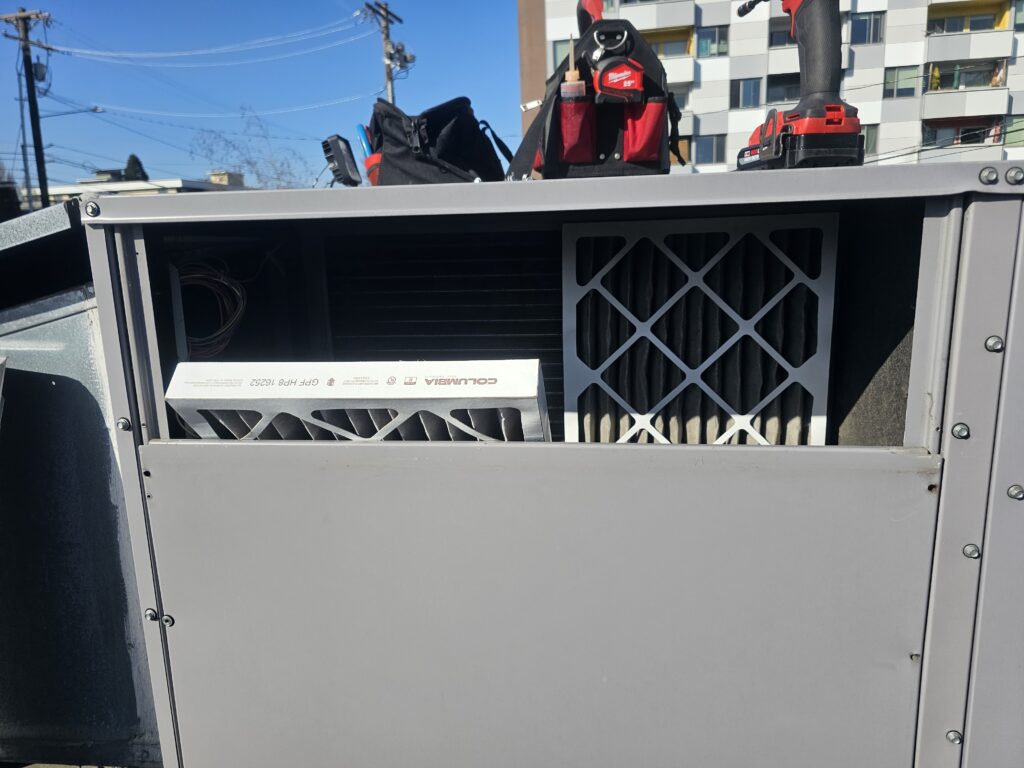
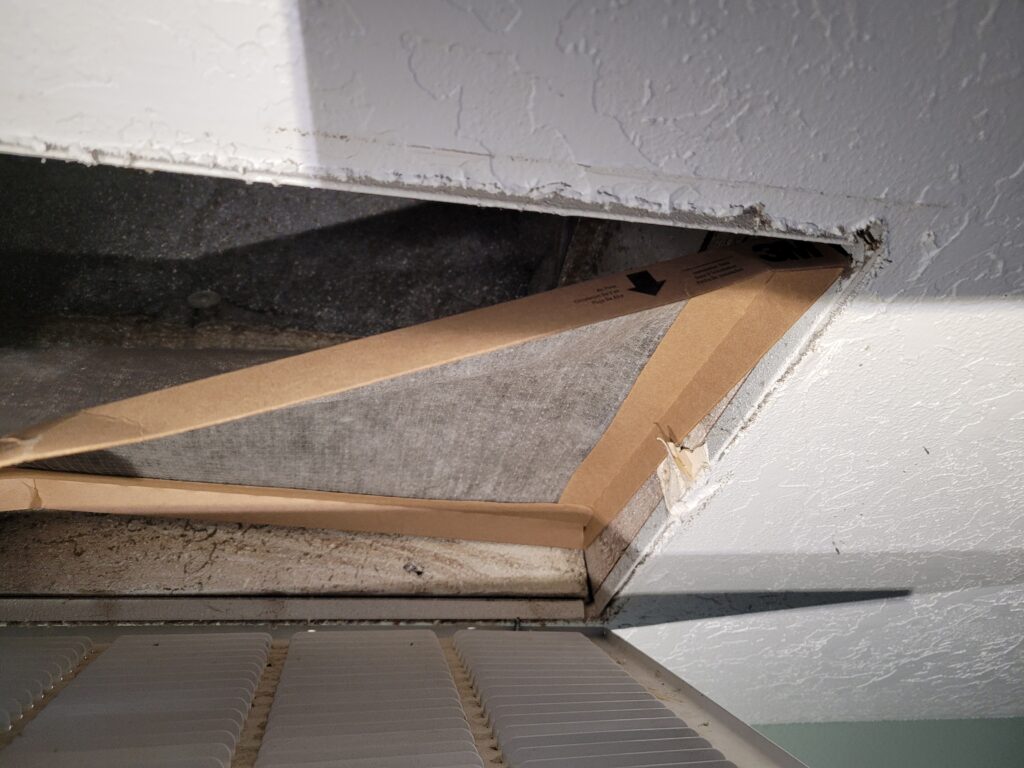
A real maintenance visit is not a glance at the thermostat and a sticker on the furnace. It's filters, coils, belts, burners, ignition parts, electrical components, and drain lines, each one looked at and, where it matters, measured. The filter is where we start, because it's the cheapest part in the system and the one most often ignored.
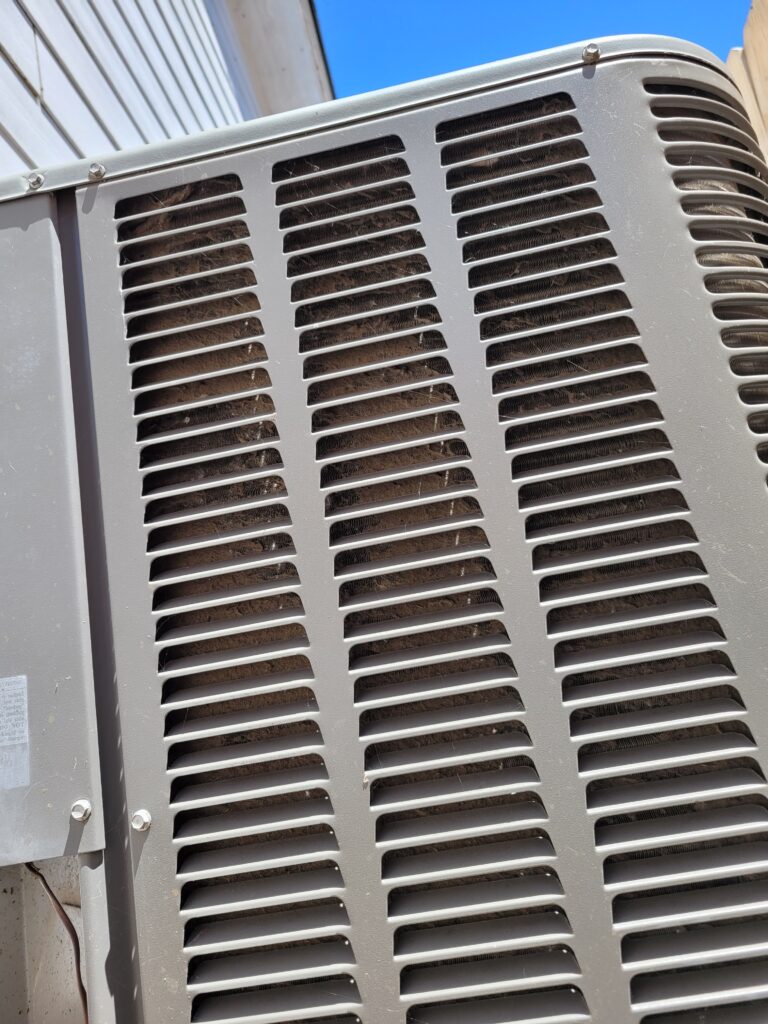
Next is the outdoor unit. Your AC's condenser coil is how the system gets rid of the heat it pulled out of your house. When the fins are packed with dirt, lint, and leaves, that heat has nowhere to go, so the system runs longer, works harder, and strains the compressor. It's one of the most common things we find, and cleaning it is part of every cooling-season visit.
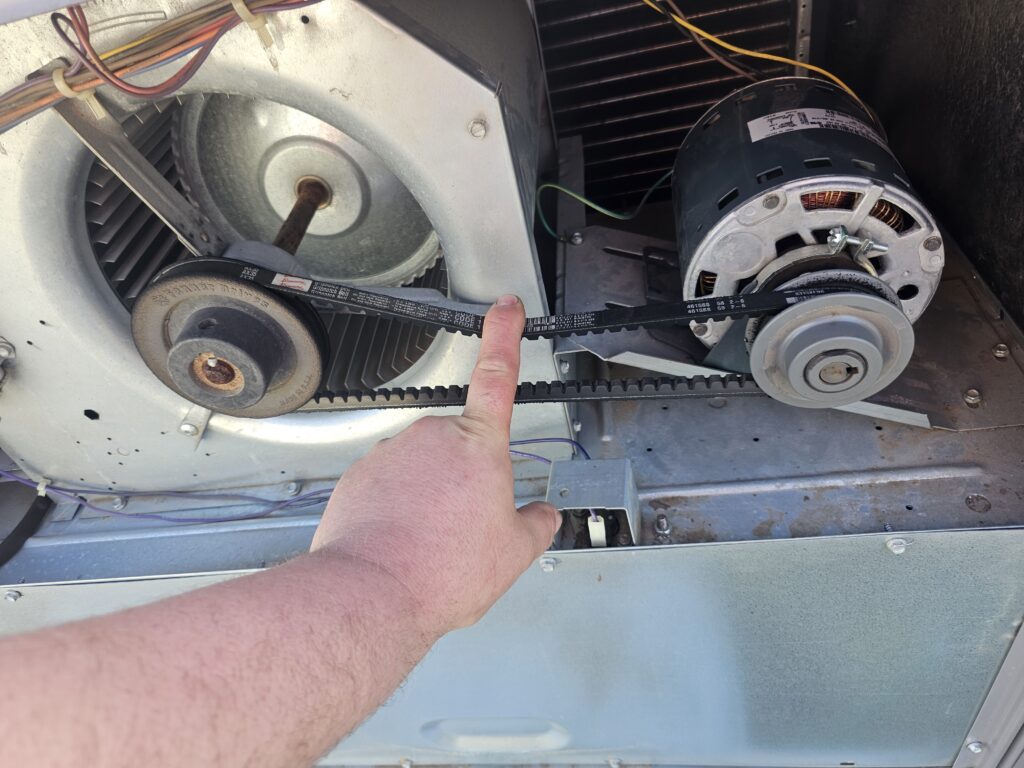
Then the moving and burning parts. On belt-driven blowers we check tension and wear, because a loose belt slips and cuts airflow while a tight one wears out bearings. On gas furnaces we look at the burners, the flame sensor, the igniter, and the heat exchanger for soot, rust, and corrosion. We test capacitors, contactors, and wiring with a meter instead of guessing, and we make sure the condensate drain is clear so water goes where it should.
Slide out your furnace filter and hold it up to a light. If you can't see light through it, swap it. It's the single easiest thing you can do for your system, and a clogged filter is behind more weak-airflow complaints than most homeowners would guess. If your filters clog fast, that's worth mentioning when you call.
Caught during maintenance vs. found during a breakdown
Here's what the same problems look like depending on when someone finds them. The left column is what we see on a scheduled visit. The right column is what those same conditions tend to turn into when nobody looks until the system stops.
| Component | Caught during maintenance | Found during a breakdown |
|---|---|---|
| Air filter | Gray and loaded, swapped on the spot | Collapsed, dust bypassing into the coil |
| Condenser coil | Light debris, cleaned during the visit | Packed fins, compressor overworking |
| Evaporator coil | Inspected and kept clear | Caked in dust, airflow choked off |
| Blower belt | Tension checked, worn belt replaced | Slipping or snapped, no airflow |
| Burners and ignition | Cleaned, flame sensor and igniter tested | Furnace lights, then shuts off |
| Capacitors and wiring | Tested with a meter before they fail | Unit won't start on a hot day |
| Condensate drain | Cleared and checked | Water in the cabinet or on the floor |
| Thermostat batteries | Swapped during the visit | A quick fix either way |
Every row reflects conditions our technicians have photographed on real service calls. Your system may show more than one.
Signs your system is overdue
Some of these you can spot from the hallway or the side yard. Others mean it's already past maintenance and into repair territory. Knowing which is which saves you a panicked call, or a call you didn't need to make.
Signs it's time for maintenance
Nothing has failed yet, but the system is telling you it hasn't been looked at in a while.
What you might notice
- The filter looks gray or you can't remember the last time it was changed.
- Leaves, grass, and debris have piled up around or inside the outdoor unit.
- Some rooms run warmer or cooler than others, or you've started using box fans to compensate.
- Registers and vent grilles are coated in dust, or furniture and boxes are sitting in front of them.
Signs you need a repair call
The system is already struggling or failing. This is past a tune-up.
Call a technician if
- The breaker for the furnace or AC keeps tripping after you reset it.
- The furnace burners light, then shut off a few seconds later.
- The AC runs but the air coming out of the vents isn't cool.
- There's water pooling around the furnace or air handler, or black belt dust inside the cabinet.
Maintenance is not a sales call
A lot of companies treat a tune-up as a way in the door to sell a new system. We'd rather fix what's actually wrong. We've been called in after another company tagged out a furnace and shut off the gas over what they called a cracked manifold. When we traced it, the real problem was a condensate pump whose contacts had corroded so badly it couldn't pass 24 volts downstream. Once we verified the system was sound, that furnace could run. On another job, two companies had already said the whole system was too old and had to go. We found an undersized breaker behind the trips, tuned up the electric furnace, and recharged the heat pump.
That's why we talk through a few things on the phone first, like checking the fan and the breaker box, to figure out whether you even need a visit. And when we do work on your system, it carries a 30-day guarantee: if we fixed it incorrectly, we come back and make it right at no charge.
If a maintenance visit ends with "replacing the whole system is your only option," slow down. Get multiple quotes, and if you can, talk to a technician rather than a salesperson. Cooling problems are often isolated to the electrical side or a low refrigerant charge. If the explanation feels like a story instead of a diagnosis, trust your gut and get a second opinion before replacing anything.
“A maintenance visit should tell you where your money is going and why. If nobody can show you what they found, you didn't get maintenance. You got a sales pitch.”— Talon Mechanical
Commercial systems need it just as much
Rooftop package units on shops, offices, and labs take the same beating, with more hours on them and fewer people looking. Dirty filters, loose belts, and fault codes flashing on a control board are routine finds on a roof. If you're responsible for a building, our commercial HVAC service keeps rooftop units on a schedule so a no-heat or no-cooling call doesn't land in the middle of a business day.
The decision matrix
Read down the left column to what you're noticing, then look across. Some things are honestly a five-minute fix you can do yourself. Others shouldn't be touched without the right tools and training. For more on that line, see what to leave to a pro.
| If you notice… | Handle it yourself | Call a technician |
|---|---|---|
| A dirty or gray filter | Yes, swap it | If it clogs fast |
| Leaves piled around the outdoor unit | Clear them by hand | For coil cleaning |
| A blank thermostat screen | Try fresh batteries | If batteries don't fix it |
| A breaker that keeps tripping | Don't keep resetting it | Yes |
| A furnace that lights, then shuts off | No | Yes |
| Squealing or belt dust in the cabinet | No | Yes |
| Water around the furnace or air handler | Not a DIY fix | Yes |
| No one has opened it up in over a year | Filter only | Schedule a visit |
The bottom line
Most heating and cooling breakdowns give warning signs long before they leave you without heat or AC: a filter that's gone gray, a coil caked with debris, belt dust in the cabinet, a burner that lights and drops out. Maintenance is simply the visit where those signs get caught while the fix is still small. Skip it long enough and the costs pile up in ways that are easy to miss, which we break down in the hidden costs of neglecting your HVAC.
If you're getting ready for the season ahead, our pre-summer AC checklist and fall heating prep guide cover what to look at first. And when you'd like a technician to open the cabinet and look, schedule a maintenance visit and we'll show you what we find.